CosmoInsider
cosmoinsider.com · EN
- 11posts a week
- 6 Novlast post
- #3in Astronomy
Astronomy, planetary science and space exploration with context and traceable sources.
Subscribe
Latest posts
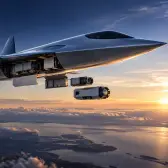
NASA unveils the X-70 Fractal, a modular experimental aircraft for testing new flight technologies
Announced on November 4 at Kennedy Space Center, the X-70 Fractal will be able to quickly change its internal and external experimental payloads. NASA projects that it will reach Mach 0.75, operate at up to 45,000 feet, and have a range of more than 1,500 nautical miles.
Webb Reveals Warm Dust Structures in the Cat's Head Nebula
The Webb image shows how warm dust emission and carbonaceous molecules outline globules and filaments within the Cat's Head Nebula. Published on October 29, 2026 alongside Hubble and Webb near‑infrared views, it offers a complementary perspective of this star‑forming zone located in the Carina…
NASA Guide to Smartphone Astrophotography: Optical Fundamentals and Calibration
NASA has released "A Guide to Smartphone Astrophotography," an educational guide authored by Dr. Sten Odenwald that explains the physical and statistical principles required to perform astrophotography with smartphones. The document addresses light pollution, sensor operation, spectral response…
NASA seeks industry input on commercial options to extend Hubble’s mission
On October 29, 2026, NASA opened an inquiry to companies about possible in-orbit services for the Hubble Space Telescope. Options include raising it to a higher orbit, improving its capabilities, and arranging a controlled reentry or safe orbital disposal at the end of the mission. Responses are…
Cosmology: How Early-Universe Imprints Help Study Its Expansion
Cosmology connects observations from different eras to study the history of the universe. The cosmic microwave background preserves the oldest light we can observe; acoustic waves in the early universe left imprints in its temperature variations and a faint signal in the clustering of galaxies. The…
ESO discovers a double gas-and-dust disk around a white dwarf
On October 27, 2026, ESO announced the discovery of a debris disk around the white dwarf WD J1328–1450. Its emission lines have four peaks, a signal the study interprets as two separate gaseous rings: one between 0.14 and 0.34 solar radii, and the other between 0.54 and 1.93. The authors propose…
NASA publishes its 2026 inventory of technologies for repairing, assembling and manufacturing in space
NASA published the 2026 edition of the ISAM State of Play on October 29, a 368-page reference on technologies for servicing spacecraft, assembling structures and manufacturing components in space. The document covers 11 functional areas and, according to the program’s official page, includes 621…
Teghaza 001: A Martian meteorite more than 4.1 billion years old
Found in the Sahara in 2022, Teghaza 001 weighs about 800 grams and is one of the oldest Martian meteorites found on Earth. Mineral dating indicates that water altered the rock around 4.1 billion years ago, after it had formed. Its mineralogy matches observations of the cratered southern highlands…
Hubble and Webb reveal the Cat’s Head Nebula in visible and infrared light
On October 29, 2026, the European Space Agency released images of a small star-forming region in the Carina Nebula, nicknamed the Cat’s Head for its shape. Hubble sees it in visible light as a dark pillar of dust; Webb’s infrared views reveal stars and details in gas and dust.
Cosmological Redshift: How Light Stretches in an Expanding Universe
As light travels through an expanding universe, it stretches and its wavelengths increase. This redshift can be measured by comparing known features in an observed spectrum with their reference positions. The measurement helps scientists study the expansion of the universe and observe light emitted…
Two Deep-Space Propulsion Papers Listed at a 2025 Conference
The International Astronautical Federation conference “Space Vehicles for Exploration & Propulsion for Deep Space” took place in New Delhi from May 7 to 9, 2025. Its proceedings list two papers relevant by title: Amogh Wagh’s “Hybrid Solar Sail and Electric Propulsion System for Deep-Space…
Euclid presents 500 gravitational lens candidates in its first data release
On March 19, 2025, the European Space Agency (ESA) published Euclid’s first survey data release, with previews of three deep fields. In one week of observations and one scan of each region, the mission detected 26 million galaxies; the most distant are up to 10.5 billion light-years away. The…
Vietnam becomes the 78th signatory to the Artemis Accords
Vietnam joined the Artemis Accords on October 28, 2026, becoming the 78th country to sign them. Minister of Science and Technology Vũ Hải Quân signed on behalf of the country during Vietnam International Digital Week in Ha Long. The accords set out principles for civil space exploration, while NASA…
ODISEA: Simulations Reproduce the Evolution of Substructures in Protoplanetary Disks
A study from the ODISEA survey combines the PlanetaLP and radmc-3D codes to reproduce key aspects of a proposed evolutionary sequence for substructures in protoplanetary disks. In the simulation, an initially smooth disk hosts a 1 M_Jup planet at 57 au: a gap appears after a few hundred orbits; by…
Webb detects signs of a neutron star at the center of supernova 1987A
Observations by the James Webb Space Telescope provide the strongest evidence yet of emission caused by a compact object at the center of the remnant of SN 1987A, a supernova observed in 1987. The analysis found ionized argon in the expelled material and, in later data, argon missing five electrons…
Orbital Fall: How Gravity and Speed Keep an Object in Orbit
An orbit does not eliminate gravity: it combines gravity with an object’s speed. NASA explains this idea through Newton’s cannon thought experiment. It also describes how energy changes at specific points can raise or lower periapsis and apoapsis, and how aerobraking can remove orbital energy.
NASA SEES students model windows for measuring IM-3 propellant
The MATRIX team in the University of Texas’ SEES program developed models to estimate when the propellant modal gauging (MPG) technique could obtain reliable readings during Intuitive Machines’ IM-3 mission. NASA published the information on October 26, 2026. The analysis used public data from IM-1…
Euclid will combine galaxy maps and gravitational lenses to study the dark universe
Euclid is a European space mission built and operated by the European Space Agency (ESA), with contributions from NASA. Its main survey will map billions of galaxies across more than a third of the sky to study the structure and evolution of the universe and its dark components. In its first public…
NASA Guide to Smartphone Astrophotography: Stability, Focus, and Exposure Techniques
NASA explains that anyone can do astrophotography with a smartphone. Key points: mechanical stability, manual focus lock, long exposure, and digital editing to reveal night sky details.
The Luna missions and what they reveal about the Moon
The Soviet Luna program achieved robotic landings, rover traverses, and automated sample returns. A review synthesizes its main findings and examines engineering lessons connected with Artemis.
In the directory since 5 Nov 2026 · last checked 9 Nov 2026 · RSS