Topics /
Miscellaneous Science RSS Feeds
1 feed from 1 site tagged “miscellaneous science”. Follow one here, or copy its address into any RSS reader.
Latest miscellaneous science posts
It’s fine to use computer-generated survey responses—if you don’t care about the data anyway!
Think about it like this: a survey organization uses a method M to get data D to give population estimates E which are used by clients to make actions A. The method M is crucial in determining data D, which … Continue reading →
Here’s a causal inference problem: where did the estimate of $64 million come from in “Blake Lively Says She Suffered $64 Million Financial Fallout From Justin Baldoni Conflict . . .”?
OK, here’s a causal inference problem for ya: Blake Lively Says She Suffered $64 Million Financial Fallout From Justin Baldoni Conflict . . . In Lively’s memorandum in opposition to Wayfarer Studios’ motion in limine filed April 17, her expert … Continue reading →
Survey Statistics: Fat Bear Week 2026
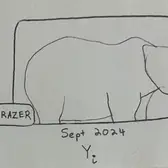
Happy Fat Bear Week to all who celebrate. In 2024 I made a cartoon called Basu’s Bears, adapted from Basu’s (1971) elephants example, a lesson on the use of auxiliary information in survey statistics. For Fat Bear Week 2025, I … Continue reading →
“Phonics is a fad, but it’s also good, so we should do it anyway, even though it will probably disappoint people”
Tyler Watts and Drew Bailey write: Educational policy is often viewed as a field of fads, where one follows another for seemingly arbitrary reasons. We might like to believe that fad-based policy could be superseded by evidence-based policy, with rational … Continue reading →
Do high school students have to work harder nowadays?
I happened to come across this old comment thread where Richard Serlin wrote: Starting early is huge. If you’re a super-workaholic, with great endurance and energy, since kindergarten you’re going to achieve far more by age 40 . . . … Continue reading →
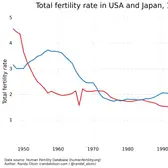
How did it go, this prediction from ten years ago about Japanese fertility in 2026?
From 2017: Gaurav Sood points us to this post, “Why did so many Japanese families avoid having children in 1966?”, by Randy Olson, which includes the excellent graph above and the following explanation: The Japanese use [an] . . . astrological … Continue reading →
The Immigration and Nationality Act of 1952
I was reading the London Review of Books and came across this article by Jameel Jaffer stating that, in 1952, Congress overrode the presidential veto and passed the McCarran-Walter Act with a two-thirds majority in the House and Senate. The … Continue reading →
Meritocracy to-morrow and meritocracy yesterday – but never meritocracy to-day
Alice couldn’t help laughing, as she said, “I don’t want you to hire me – and I don’t care for jam.” “It’s very good jam,” said the Queen. “Well, I don’t want any to-day, at any rate.” “You couldn’t have … Continue reading →
Scientific citations as an overwhelmed communication channel
Peter Dorman writes: This looks like it’s up your alley. I find it interesting, but I’m not convinced by what he says about innovation. Of course, the issue is empirical, but I suspect it may be different for different sciences. … Continue reading →
It’s satisfying to see the economics profession come around on some things (regression discontinuity analysis and so-called risk aversion)
Jonathan Falk points to this post by Nicholas Decker and writes: I thought you’d be interested in a couple of things in this. First, the regression discontinuity pictures and Decker’s parenthetical warning: “(The econometrics literature is emphatic on this – … Continue reading →
Charting the Agentic Garden of Forking Paths
Arjun Balaji, Batuhan Duru Yeltekin, and Tian Zheng write: Even with a fixed dataset and research question, data analysis involves many defensible decisions. Understanding how these choices influence the results is scientifically important but remains challenging. Crowdsourcing and agentic AI ……
Survey Statistics: ANOVA
Andrew recently answered “Why did ANOVA fall out of fashion?”: Anova is still important; it’s just been subsumed by hierarchical models. The link is to my 2005 paper, Analysis of variance: Why it is more important than ever Folks discussed … Continue reading →
“Protection from inappropriate influence is a hallmark of scientific integrity” . . . not any more!
This is a funny one. Remember how Google used to have the slogan, “Don’t be evil,” but then they abandoned it? Something similar seems to have happened with the U.S. Census Bureau. Dale Lehman pointed me to the story: I’m … Continue reading →
The Washington Nationals are hiring!
Des McGowan writes: I left the Mets last year to take a job as the Amateur Scouting Director with the Washington Nationals. Now that we’ve gotten through our first draft and trade deadline, we’re looking for two Senior Analysts who … Continue reading →
New York City Psychometrics Group
[Edit to correct the attribution. Sorry about that! Bob.] Klint Kanopka (NYU) put together a New York City Psychometrics Group, which hosts events. They have a web site with more information New York City Psychometrics Group There are three events … Continue reading →
This is how we do modern frequentist statistics: Using fake-data simulation to understand what can happen in a study
In a famous (to readers of this blog) example of statistical error, a researcher reported that beautiful parents were 36% more likely to have girl babies. The saps at Freakonomics fell for this one hook, line, and sinker, but I … Continue reading →
What’s happening with the models of the Atlantic Meridional Overturning Circulation?
John “not Towering Inferno” Williams points to this new research article by Valentin Portmann et al., which states: Climate models show considerable discrepancies in their future projections around the Atlantic, mainly due to uncertainties in the fate of the Atlantic … Continue reading →
Annals of hype: Did this discovery in 2012 mark “the discovery of the final laws of nature . . . a discontinuity in human intellectual history, the sharpest that has occurred since the beginning of modern science in the 17th century?”
Here’s Ed Regis in 1993, reviewing a book from that year by physicist Steven Weinberg: Currently, the most favoured explanation for the electroweak asymmetry involves the postulation of a new elementary particle, the so-called Higgs boson . . . One … Continue reading →
Why I don’t like highest posterior density (HPD) intervals
This post is by Bob There are several reasons I prefer central intervals. First, you can’t tell how much of the probability is above or below a highest posterior density interval. For example, if I look at the HPD for … Continue reading →
“Belief” is not something you have; rather, it’s a relationship between thought and action.
I came across this piece by John Ziman from 1989, in the middle of the “cold fusion” hoopla: When scientific controversies erupt like this, one must obviously try to grasp the essential points at issue. The mere fact that these … Continue reading →